

Cell Genomics: PRECI SCS-R300 Powers In Situ Microbial Single-Cell Omics
-
Customer
-
Fudan University

-
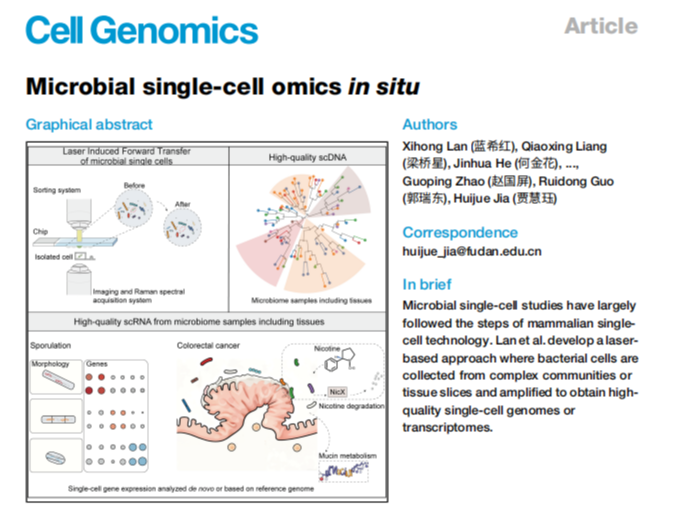
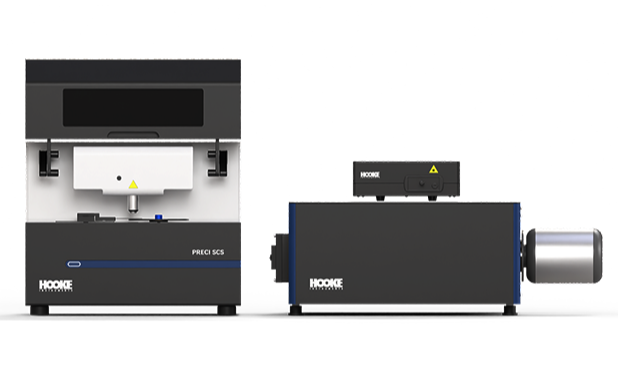
In a landmark Cell Genomics study, researchers from Fudan University and collaborating institutions used the PRECI SCS-R300 Raman Single-Cell Sorter from Hooke Instruments to overcome one of microbiome research’s most persistent challenges: recovering individual microbial cells from complex biological samples while preserving their phenotypic and spatial information.
Using PRECI SCS-R300, the team successfully isolated single microbial cells directly from human saliva, mouse intestinal tissue and colorectal cancer tissue sections, and generated high-quality single-cell genomic and tranomic data. By combining visual cell identification, Raman spectral characterization and precise LIFT-based cell isolation, the platform enabled researchers to target specific cells before sequencing, significantly improving the efficiency and biological relevance of downstream single-cell analysis.
The study highlights the unique value of PRECI SCS-R300 in bridging the gap between what researchers observe and what they sequence, creating a direct link between microbial phenotype, spatial context and molecular function. For scientists working in microbiome, clinical and environmental research, this represents a powerful new approach for discovering rare, functionally important microbial cells that would otherwise remain hidden in bulk sequencing datasets.
The research, titled “Microbial single-cell omics in situ,” was published in Cell Genomics in 2026.
In the following sections, we examine the scientific challenges addressed by the study, the experimental workflow and key findings, and how Hooke Instruments technology supported the generation of high-quality microbial single-cell omics data.
01. Scientific Challenge
Microbial single-cell omics has the potential to reveal the functional diversity of individual microorganisms, but recovering intact microbial cells from complex microbiomes and tissue environments remains a major technical challenge. Traditional approaches often lose spatial information and struggle to link microbial phenotype with downstream genomic or tranomic analysis.
To overcome these limitations, the researchers sought a solution capable of identifying, characterizing and isolating target microbial cells prior to sequencing.
02. Experimental Workflow
The team established an integrated microbial single-cell omics workflow combining microscopy, Raman phenotyping, LIFT-based cell isolation and downstream sequencing.
Using PRECI SCS-R300, target cells could be selected based on morphology, fluorescence signals or Raman fingerprints, then individually recovered for genome or tranome analysis. This workflow enabled researchers to move directly from cell observation to single-cell omics characterization.
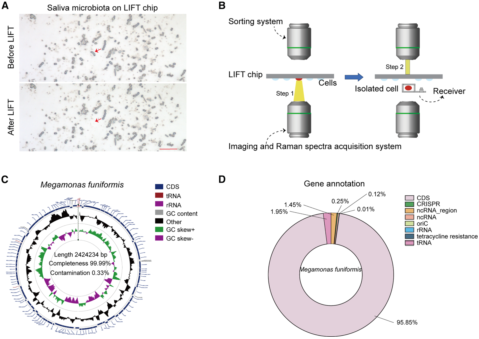
Figure 1. High-quality microbial single-cell draft genome obtained from saliva.
03. Key Findings
3.1 High-Quality Genomes from Complex Microbiomes
PRECI SCS-R300 enabled precise recovery of individual bacterial cells from human saliva and other complex microbiome samples, generating high-quality single-cell genomes with high completeness and low contamination.
Recovered a Megamonas funiformis single-cell genome with 99.99% completeness and only 0.33% contamination.
Generated 39 single-cell assembled genomes (SAGs) from saliva microbiota spanning multiple bacterial taxa.
Achieved genome quality comparable to cultured isolates and exceeding many conventional single-cell genome assemblies.
Automated image-based selection enabled isolation of 34–62 bacterial cells per minute, supporting higher-throughput workflows.
3.2 Raman-Guided Discovery of Functional Cell States
By integrating Raman spectroscopy with single-cell tranomics, the researchers successfully identified bacterial cells at different developmental stages and linked phenotypic differences to gene-expression profiles. This demonstrated the value of phenotype-guided cell selection before sequencing.
Acquired Raman spectra from more than 50 cells per developmental stage, generating distinct spectral clusters corresponding to different cellular states.
Identified 194 differentially expressed genes associated with stress response, membrane remodeling and sporulation.
Distinguished five tranionally distinct sporulation states within a single bacterial population.
Demonstrated strong agreement between morphology, Raman fingerprints and tranomic profiles.
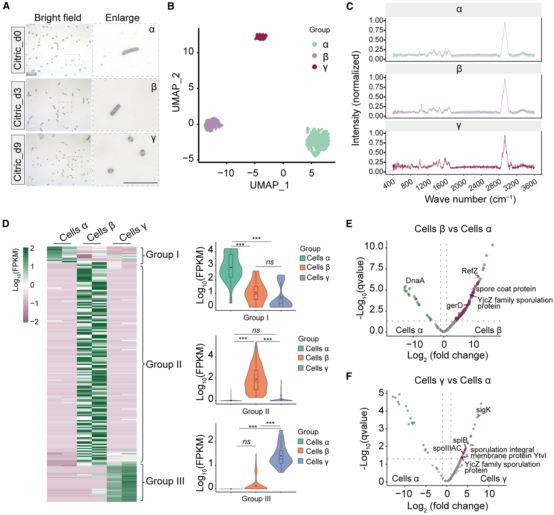
Figure 2. Coherent grouping of sporulating bacterial cells by morphology, Raman spectra and single-cell RNA tranome.
3.3 In Situ Analysis of Tissue-Associated Microbiota
The workflow was further extended to mouse gut and human colorectal cancer tissues, where individual bacteria were isolated directly from tissue sections and analyzed at single-cell resolution. These results highlight the potential of in situ microbial omics in clinical and host–microbe interaction studies.
Isolated 25 individual bacterial cells directly from mouse gut tissue sections.
Recovered 3 high-quality genomes and 5 medium-quality genomes from tissue-associated bacteria.
Successfully isolated and sequenced a 1.33 μm tissue-resident bacterial cell from human colorectal cancer tissue.
Obtained a microbial single-cell tranome containing 2,756 trans, with 75% assigned to Bacteroides, enabling functional characterization of tissue-associated microbes.
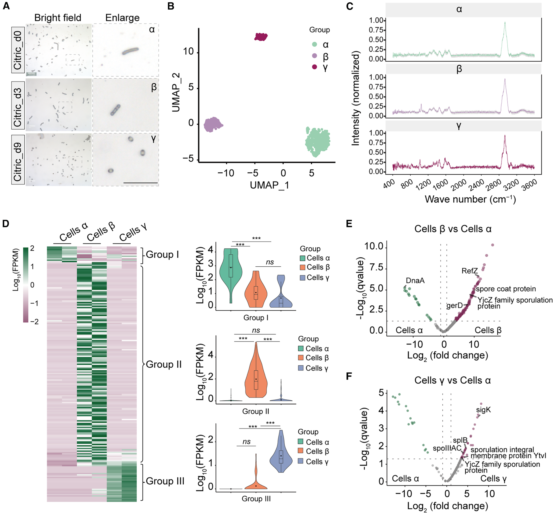
Figure 3. Genomic sequencing of a single microbe in colorectal cancer tissue.
3.4 Scalable and Cost-Effective Single-Cell Omics Workflow
The study also demonstrated that automated LIFT isolation can support scalable microbial single-cell analysis while reducing reagent consumption.
Reduced downstream reaction volume from 50 μL to 5.3 μL without compromising genome quality.
Generated 28 single-cell genomes under reduced-volume conditions.
Achieved >95% average nucleotide identity (ANI) between recovered genomes and reference strains.
Maintained comparable completeness, contamination and coverage across reaction volumes.
Customer Outcomes
-

 Cell Genomics | Microbial single-cell omics in situ2026.03.02